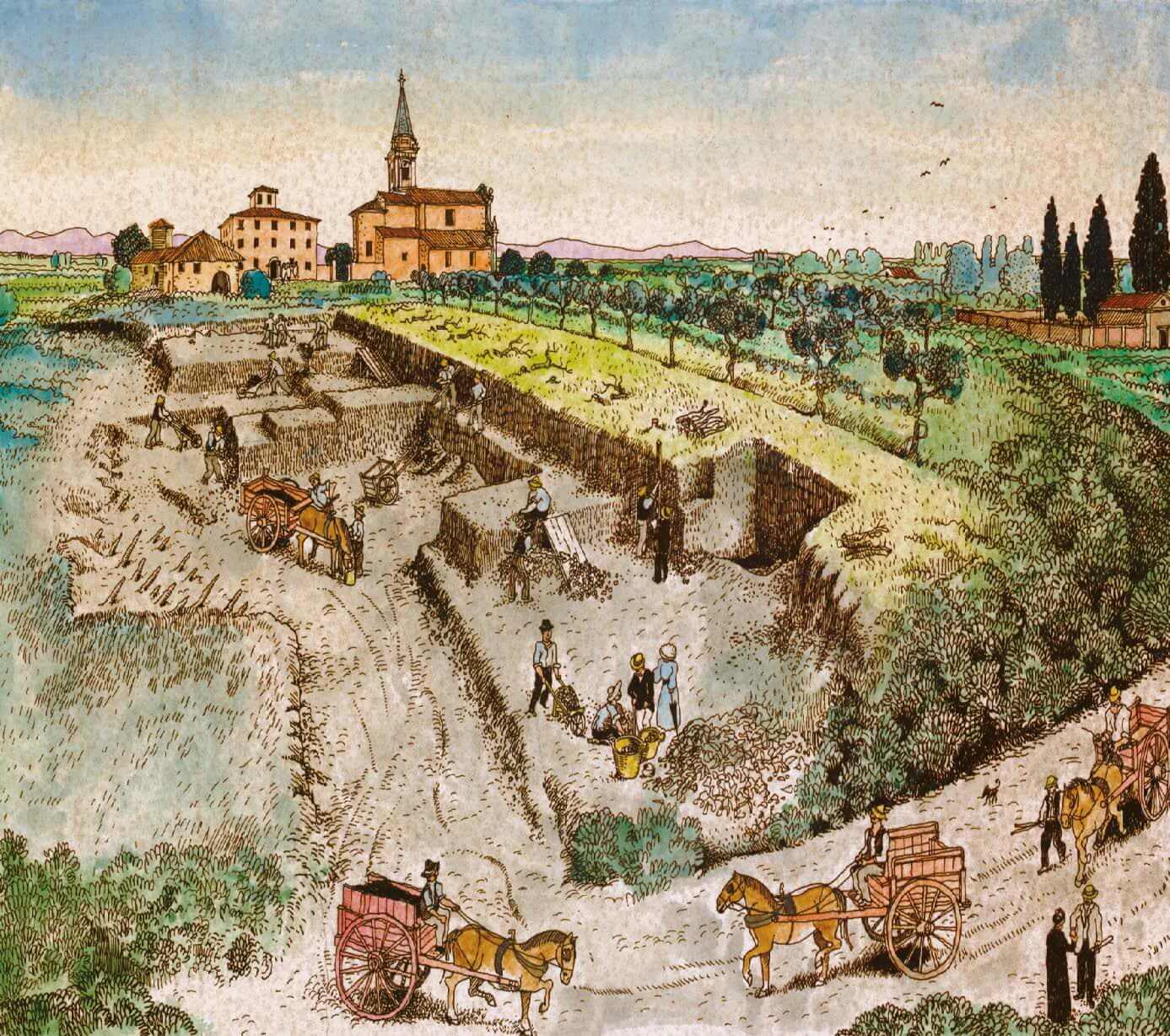
At the beginning of the 19th century the name terremare denoted organic topsoil pits mined from low hills and sold to fertilise fields.
These reliefs, frequent in the Po Valley landscape, were not, however, of natural origin and were long attributed to the remains of Roman or Celtic settlements or necropolises.
Only after 1860when scientific research into prehistory began to intensify in Italy, it was realised that the true origin of these hillocks was attributable to Bronze Age villages which have since been called terramare.
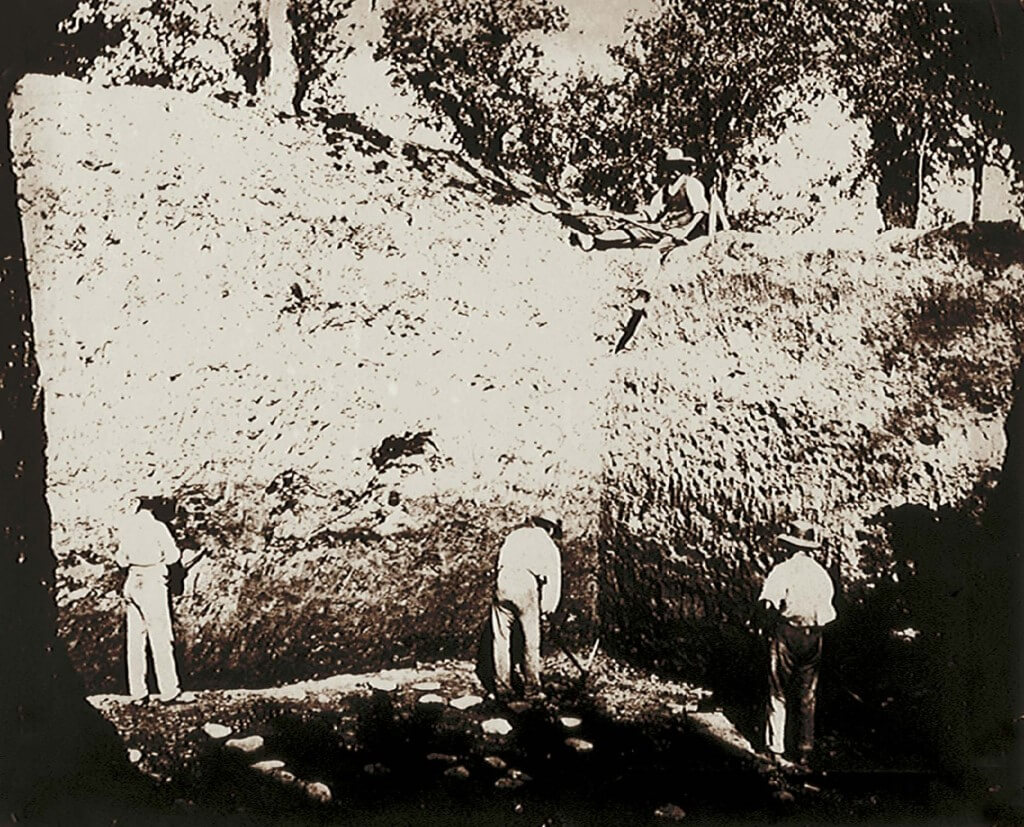
In Montale is Carlo Boni to identify the remains of a terramara on the hillock. His research aroused the interest of the scholars from all over Europe which, on the occasion of the International Congress of Prehistoric Anthropology and Archaeology, organised in Bologna in 1871visited the excavations.
In the same year Carlo Boni founded the Civic Museum of Modena and the institution received the first materials that emerged from the excavation, which were later joined by numerous finds from other terramares in the Modena area.
Montale also suffered the same fate as other terramares and soon a extraction of organic soil that formed the mound. For a few years, the Museum of Modena continued to take care of the terramara through excavations and inspections of the quarry works, but after Boni's death in 1894, the knoll was almost completely destroyed and only the part closest to the church was saved.
After 100 years the Museo Civico di Modena in agreement with the Soprintendenza per Beni Archeologici dell'Emilia Romagna has resumed research that has uncovered traces of the village fortifications, one of the few intact archaeological deposits attributable to a terramara.
The results of these excavations have not only made it possible to plan the reconstruction of part of the village, but have significantly enriched our knowledge of the structures, productions and chronology of the terramare.